
How does a lithium battery work and what are its advantages?
Lithium batteries: the technology that powers our modern life
Today, lithium batteries are present in almost every aspect of our lives: from electric vehicles and mobile devices to solar energy storage in residential systems. These batteries have had a massive impact and have completely transformed the way we live. However, few people know how this technology actually works, what its advantages are, and how important it is for improving our quality of life.
The loading and unloading process
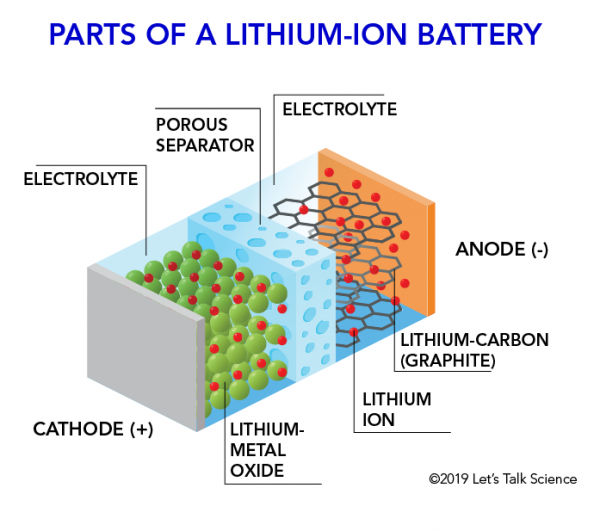
A lithium-ion battery works through reversible electrochemical processes that allow it to store and release electrical energy through the controlled movement of lithium ions between two electrodes: the cathode and the anode. These electrodes are separated by an electrolyte that allows the passage of lithium ions, but not electrons, forcing the electrons to circulate through an external circuit.
During the discharge process, which is when the stored energy is used to power a device, lithium ions move from the anode to the cathode through the electrolyte. Simultaneously, electrons flow from the anode to the cathode through the external circuit, generating a usable electrical current. This flow of electrons supplies power to the connected equipment, while the potential difference between the two electrodes drives the discharge process. As the battery discharges, the concentration of lithium ions at the anode decreases, and the battery voltage gradually drops.
During the charging process, an external power source applies a voltage higher than the battery's internal voltage, forcing a reversal of the electrochemical process. A lithium-ion cell has a typical nominal voltage of approximately 3.7 V, but to fully charge it requires the charger to raise the voltage to around 4.2 V per cell. This controlled overvoltage causes electrons to be forced to move toward the anode, while lithium ions internally migrate from the cathode to the anode, where they are stored again by intercalation within the active material structure.
As the battery charges, the amount of lithium ions stored in the anode increases, gradually raising the cell's internal voltage. When this voltage reaches the safe limit of approximately 4.2 V and the charging current drops to a very low level, the charging system interprets this as the battery having reached its maximum usable capacity and considering it fully charged, that is, at 100% of its state of charge.
What are the advantages and disadvantages of a lithium battery?
Lithium batteries offer numerous advantages compared to traditional battery materials such as nickel-cadmium or lead-acid. Their widespread adoption in electronic devices, power tools, and energy storage systems is primarily due to their efficiency, energy density, and versatility. However, like any technology, they also have certain drawbacks that must be understood for proper and safe use.
Among the main advantages of lithium batteries is their high energy density, meaning they can store a large amount of energy in a relatively small volume and weight. This characteristic makes them ideal for mobile devices such as cell phones, laptops, cameras, and other electronic equipment where space and weight are critical factors. Thanks to this capacity, devices can operate for longer periods without increasing their physical size.
Another important advantage is their high discharge capacity, known as high -drain or high- discharge rate. Lithium batteries can deliver large amounts of energy in short periods of time without a significant voltage drop. This makes them especially suitable for power tools and high-drain equipment, such as drills, chainsaws, and other power machines that require high instantaneous torque, for example, when drilling or screwing into concrete surfaces.
Furthermore, lithium batteries can be easily integrated into larger battery banks. Multiple cells can be connected in series and parallel to increase voltage, total capacity, or both. This flexibility makes them a common solution in residential energy storage systems, solar installations, electric vehicles, and industrial applications where expanded and scalable energy capacity is required.
However, these same characteristics that make lithium batteries so efficient also represent some of their disadvantages. Because they are capable of storing large amounts of energy, a mechanical, electrical, or thermal failure can be dangerous. When a lithium battery is physically damaged, overcharged, or exposed to high temperatures, a phenomenon known as thermal runaway can occur. This process causes an uncontrolled increase in internal temperature, which can lead to the sudden release of flammable gases, fire, and, in extreme cases, a thermal explosion—not an explosive like a chemical explosion, but a violent rupture caused by the accumulation of pressure and heat within the cell.
Another significant drawback is recycling. Currently, lithium battery recycling is neither as common nor as economically viable as recycling other types of batteries, such as the lead-acid batteries used in automobiles. Lead is highly recyclable and its recovery is profitable, reaching values of up to $0.30 per pound, which can represent around $20 for a typical automotive battery. In contrast, the lithium recycling process is more complex, expensive, and less developed, making it often cheaper to extract new materials than to reuse existing ones.
Finally, lithium batteries face significant transportation limitations. Due to their fire risk, they are subject to strict regulations, particularly for air transport. Many lithium batteries are prohibited or severely restricted on commercial flights, forcing their distribution to rely primarily on ground transportation. This restriction can increase logistical costs and limit delivery speed, especially in island or remote regions.
Sources:
Lets Talk Science: https://letstalkscience.ca/educational-resources/stem-explained/how-does-a-lithium-ion-battery-work